

Recommender Systems: New Algorithms and Current Practices

The AI and Digital Science Institute at the HSE Faculty of Computer Science hosted a conference focused on cutting-edge recommender system technologies. In an atmosphere of active knowledge sharing among leading industry experts, participants were introduced to the latest advancements and practical solutions in recommender model development.
The conference brought together experts in the development of recommender systems—a promising technology with applications in both academia and industry. The conference was organised by the Laboratory for Matrix and Tensor Methods in Machine Learning headed by Maxim Rakhuba.

Evgeniy Frolov
According to Evgeniy Frolov, Senior Research Fellow at the laboratory and Head of the Personalisation Technologies Group at AIRI, 'The second iteration of the Recommender Systems Conference brought together a community of industry and academic experts, highlighting both a strong technological foundation and a growing interest in the field. The conference programme covered a wide range of topics, from recent research submitted to RecSys 2025—the leading conference on recommender systems—to in-depth reviews of production architectures used by major companies. A notable highlight was the roundtable discussion on how well-tuned single-stage solutions could serve as a stepping stone toward a unified, LLM-oriented recommender paradigm. From my perspective, the main outcome of the conference is the emergence of a community of industry and academic experts that enables honest hypothesis testing on real-world data and provides immediate insight into its value for both business and science.'
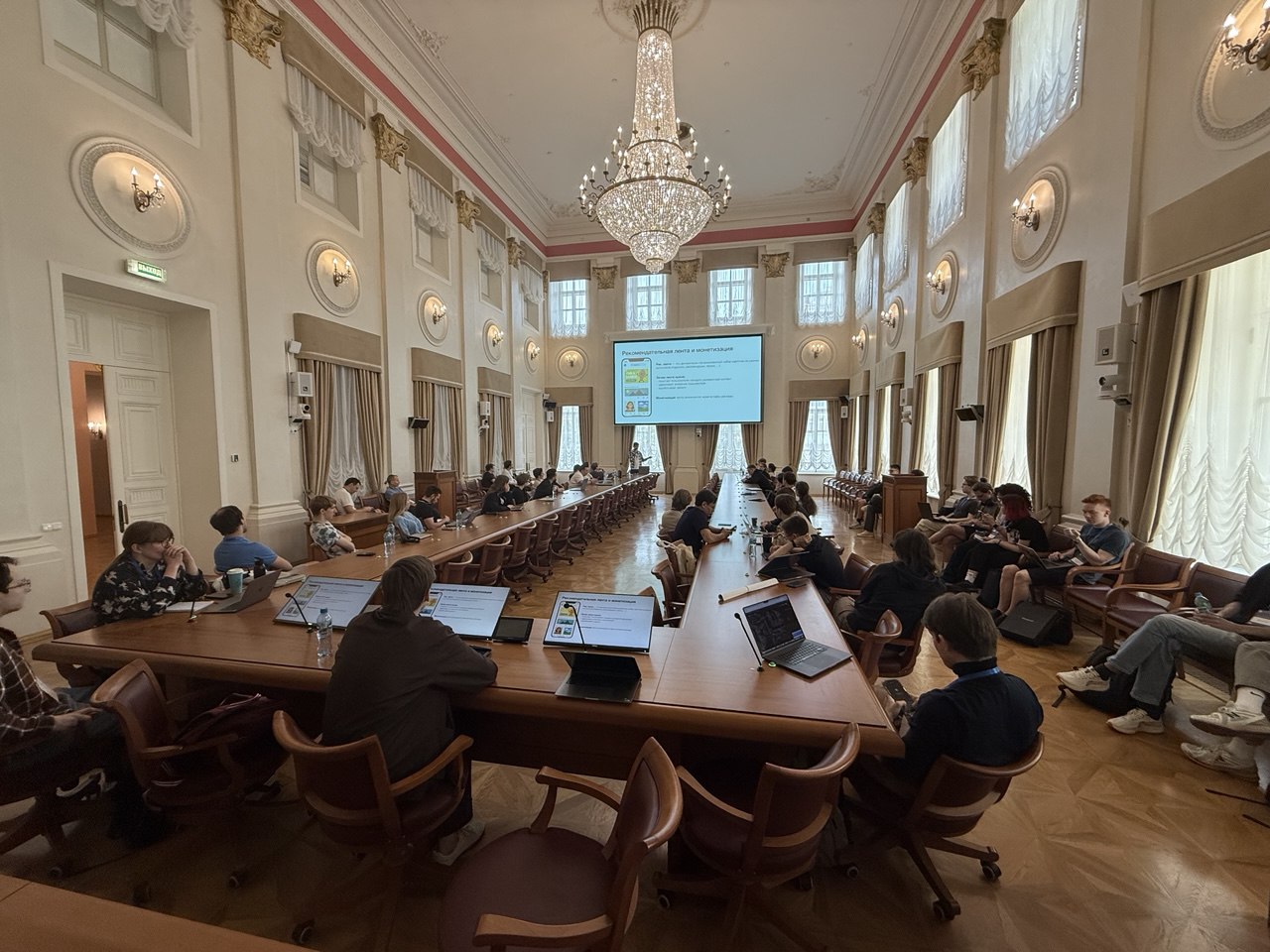
At a training seminar held during the conference, AI researchers Gleb Mezentsev and Danil Gusak provided a detailed overview of modern approaches to building scalable and consistent recommender systems. Participants explored the latest approaches to building efficient data pipelines for processing large amounts of data, as well as the complexities of integrating recommender solutions into real-world business processes.
Sergey Ermilov, Senior Developer at VK AI, presented research findings on the impact of advertising integrations on recommender service effectiveness and outlined successful strategies for content relevance and advertising returns.
Ruslan Israfilov, Sber RecSys Team Leader, delivered a presentation titled 'The Next Step in AI Evolution: LLM-based Multi-Agent Systems,' highlighting the benefits of integrating multiple intelligent agents to improve recommendation accuracy and better understand user behaviour.

Marina Ananyeva
Marina Ananyeva, Head of RecSys at the Laboratory for Matrix and Tensor Methods in Machine Learning, discussed the shift from traditional batch learning methods to online recommender models. She presented practical cases illustrating the transition to online learning, underscoring how models adapt more quickly to changes in audience preferences.
Alexey Vasilev, Executive Director of Data Science at the Sber AI Lab, emphasised the critical role of proper data preparation in developing high-quality recommender systems. His presentation covered topics such as model architecture selection, training process optimisation, and algorithm result interpretation. 'The conference was attended by experts from leading Russian companies. I know many of the speakers personally, so it was a pleasure to reconnect,' says Alexey Vasilev. 'The excellent variety of presentations—from both industry and academia—along with the poster session, made the event truly interesting. It was great to see the discussions continue during the breaks, once again confirming that recommender systems are a highly relevant and in-demand topic. I believe the conference was a success.'
In his presentation, Evgeniy Frolov proposed an innovative approach to enhancing recommender system performance by dynamically adjusting the structure of internal data representations—a method that can significantly improve recommendation quality and reduce the likelihood of errors. 'At the conference, I presented our new paper introducing a self-supervised approach to training recommender models. We adapted the Barlow Twins method, originally developed in the field of computer vision, for transformer-based recommender architectures. In particular, beyond improving prediction quality, we were the first to identify the effect of adaptive collapse in representations: depending on the structure of user preferences, the algorithm automatically adjusts the diversity of its outputs. In datasets without clear clusters of user tastes, it generates a broad range of recommendations, while in scenarios with strictly defined, specific preferences, it focuses on the most relevant products—delivering more accurate choices compared to existing methods,' explains Frolov.

The conference concluded with a poster session in the atrium of HSE University's building on Pokrovsky Bulvar, where participants discussed the presented research in an informal setting and exchanged ideas on emerging directions in recommender technology development.
This was the second Conference on Recommender Systems hosted by HSE University, and it is becoming a key platform for discussing scientific breakthroughs and technological innovations in AI and the digital economy. The event contributes to the advancement of the recommender systems industry and the emergence of a new generation of professionals in the field.
See also:

Banking Crises Drive Biodiversity Loss
Economists from HSE University, MGIMO University, and Bocconi University have found that financial crises have a significant negative impact on biodiversity and the environment. This relationship appears to be bi-directional: as global biodiversity declines, the likelihood of new crises increases. The study examines the status of populations encompassing thousands of species worldwide over the past 50 years. The article has been published in Economics Letters, an international journal.
Scientists Discover That the Brain Responds to Others’ Actions as if They Were Its Own
When we watch someone move their finger, our brain doesn’t remain passive. Research conducted by scientists from HSE University and Lausanne University Hospital shows that observing movement activates the motor cortex as if we were performing the action ourselves—while simultaneously ‘silencing’ unnecessary muscles. The findings were published in Scientific Reports.
Russian Scientists Investigate Age-Related Differences in Brain Damage Volume Following Childhood Stroke
A team of Russian scientists and clinicians, including Sofya Kulikova from HSE University in Perm, compared the extent and characteristics of brain damage in children who experienced a stroke either within the first four weeks of life or before the age of two. The researchers found that the younger the child, the more extensive the brain damage—particularly in the frontal and parietal lobes, which are responsible for movement, language, and thinking. The study, published in Neuroscience and Behavioral Physiology, provides insights into how age can influence the nature and extent of brain lesions and lays the groundwork for developing personalised rehabilitation programmes for children who experience a stroke early in life.
Scientists Test Asymmetry Between Matter and Antimatter
An international team, including scientists from HSE University, has collected and analysed data from dozens of experiments on charm mixing—the process in which an unstable charm meson oscillates between its particle and antiparticle states. These oscillations were observed only four times per thousand decays, fully consistent with the predictions of the Standard Model. This indicates that no signs of new physics have yet been detected in these processes, and if unknown particles do exist, they are likely too heavy to be observed with current equipment. The paper has been published in Physical Review D.
HSE Scientists Reveal What Drives Public Trust in Science
Researchers at HSE ISSEK have analysed the level of trust in scientific knowledge in Russian society and the factors shaping attitudes and perceptions. It was found that trust in science depends more on everyday experience, social expectations, and the perceived promises of science than on objective knowledge. The article has been published in Universe of Russia.
Institute for Robotics Systems Established at HSE University
As decided by the HSE University Academic Council, a new Institute for Robotics Systems will be established at HSE, and with a strong fundamental base. It will cooperate with relevant departments across the university and engage students and doctoral candidates in research and development (R&D). First Vice Rector of HSE University and Director of the Institute for Statistical Studies and Economics of Knowledge, Leonid Gokhberg, discussed the expected practical results and the framework for cooperation with an industrial partner.
HSE Seeks New Ideas for AI Agents: Initiative Competition Launched
HSE University is inviting researchers and lecturers to present concepts for new digital products based on artificial intelligence. The best projects will receive expert and technological support. Applications are open until December 19, 2025.
Final of International Yandex–HSE Olympiad in AI and Data Analysis Held at HSE University
Yandex Education and the HSE Faculty of Computer Science have announced the results of the international AIDAO (Artificial Intelligence and Data Analysis Olympiad) competition. Students from 14 countries took part. For the second year in a row, first place went to the team AI Capybara, which developed the most accurate AI model for an autonomous vehicle vision system.
AI Lingua Included in Compilation of Best International AI Practices in Higher Education
HSE University has been acknowledged internationally for its pioneering efforts in integrating artificial intelligence into higher education. The AI Lingua Neural Network developed at HSE was included in the renowned international collection ‘The Global Development of AI-Empowered Higher Education: Beyond the Horizon.’ The compilation was prepared by the Institute of Education (IOE) of Tsinghua University with the support of the Ministry of Education of the People's Republic of China and a global advisory committee, which included experts from Oxford, UCL, Sorbonne, Stanford, and other leading academic centres.
IDLab: Fascinating Research, Tough Deadlines, and Academic Drive
The International Laboratory of Intangible-driven Economy (IDLab) was established at the HSE campus in Perm 11 years ago. Its expertise in data processing and analysis allows researchers to combine fundamental studies with applied projects, including the development of risk and cybersecurity models for Sber. The head of the laboratory, Professor Petr Parshakov, and Senior Research Fellow Professor Mariya Molodchik spoke to the HSE News Service about IDLab’s work.