

‘We Demonstrated That HSE University Can Not Only Build a Satellite, but Maintain Its Operation’
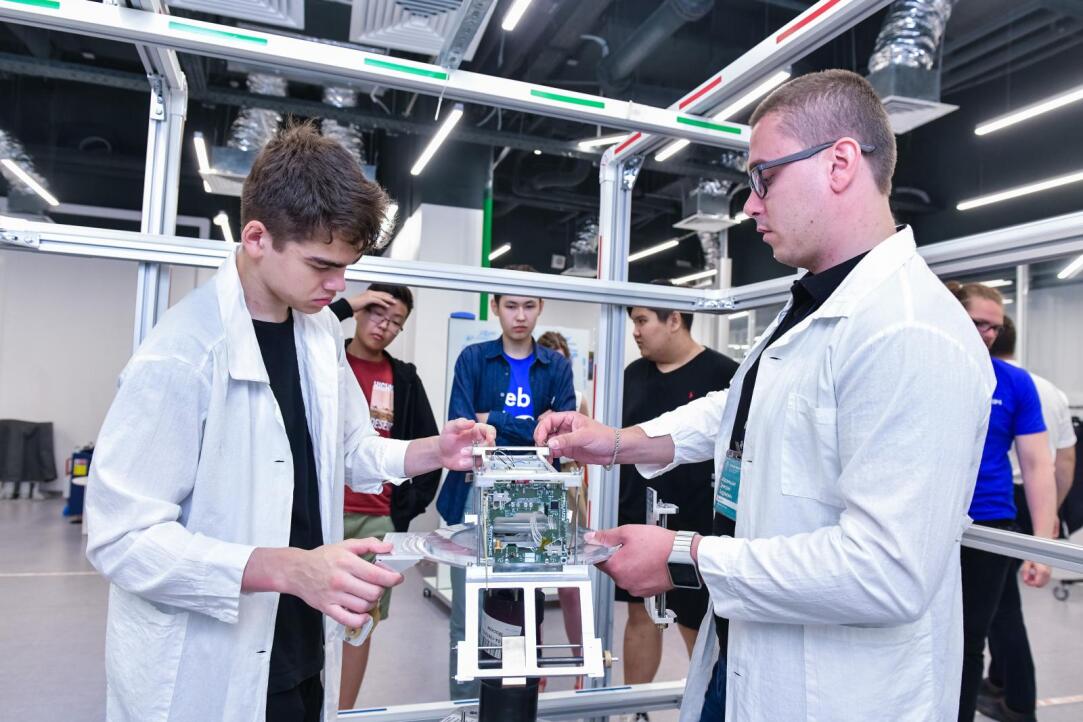
The first HSE University satellite has completed its work in orbit after more than 35,000 hours of trouble-free operation, one billion kilometres travelled (24,600 orbits around the Earth), and hundreds of full-frame shots taken of the Earth's surface across an area of 320,000 km2. The HSE News Service shares the results of the satellite’s mission and the team’s plans for the near future.
The CubeSX-HSE and CubeSX-Sirius-HSE satellites were the first CubeSats launched by HSE University and the Sirius Educational Centre. The global SatNOGS catalogue now lists both devices as ‘Decayed,’ officially signalling the completion of a four-year orbital mission—three times longer than their formal one-year warranty and almost double the statistically reliable limit for standard CubeSat platforms.
Launched on March 22, 2021, on a Soyuz-2.1 commercial flight with a Fregat unit, the pair of three-unit satellites entered a Sun-synchronous orbit about 550 km high alongside three dozen more satellites. The initial estimated life of the OrbiCraft-Pro platform—12 months of active operation—was chosen as a compromise between expense and statistics; according to industry estimates, the probability of maintaining the functionality of a classic CubeSat a year after launch does not exceed 60%. This makes the final outcome all the more impressive: a four-year, trouble-free marathon spanning about one billion km (24,600 orbits), the equivalent of several dozen round trips from Earth to Mars. The final descent began in April–May 2025, when the perigee of both vehicles dropped below 200 km; the calculated models showed a linear increase in aerodynamic drag.
The main scientific programme was carried out by the world's first flat harmonic diffractive lens, with a diameter of 10 mm and embedded in a 3D-printed metal camera box. A series of calibration surveys proved that ultrathin optics produce an image comparable to classical refractive optics; the results are described in an article in Remote Sensing 14 (9): 2230 (2022). In total, the pair of satellites collected more than 320 full-frame shots of the Earth's surface, from the cellular clouds of the Barents Sea to the spring flood on the Volga, with a total area of over 300,000 km2, a milestone recorded by the HSE team at the three-year mark of the mission.
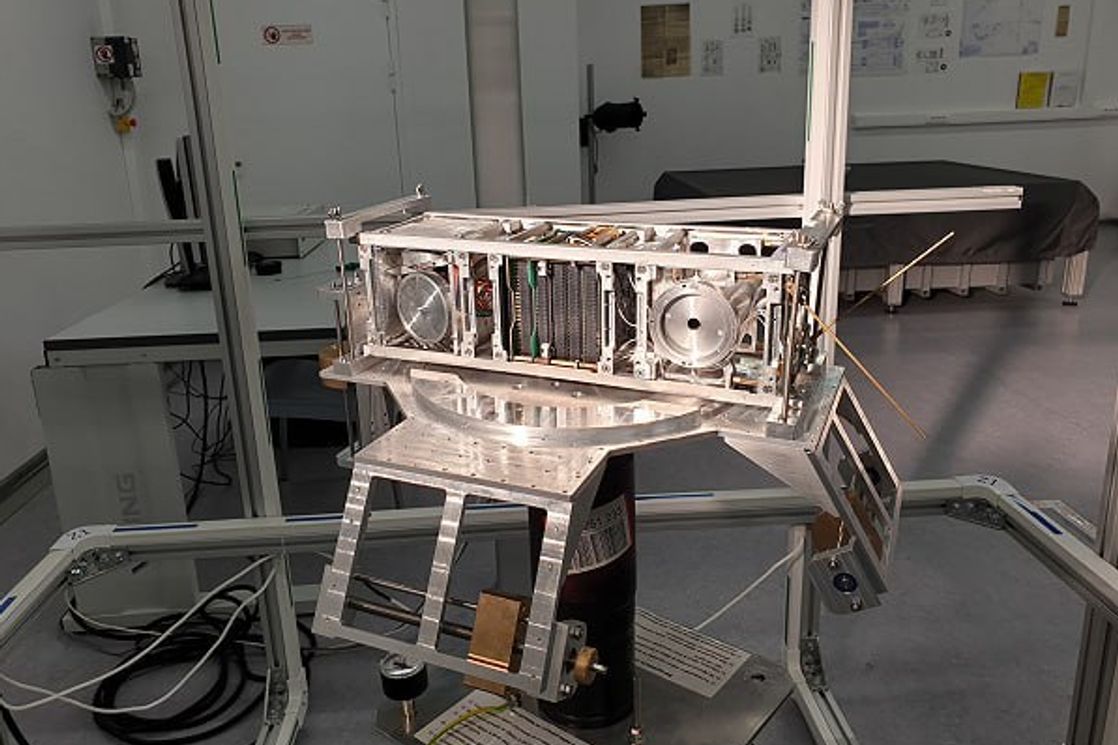
The reliability of the on-board electronics surpassed even optimistic forecasts: the total operating time of critical modules exceeded 35,000 hours without a single emergency restart. The chosen form of open channel, an AX.25 amateur radio format in the UHF range, played an important role. This meant that only the SatNOGS network of ground stations was able to receive and decrypt over 4,000 sessions (three leading observers monitored the broadcasts almost daily until the satellites’ orbits decayed), and each successfully decoded transmission appeared in real time in the open SatNOGS API.
The mission also served as a vibrant educational platform. Over the past four years, more than 15 students have taken part in the work of the MIEM Mission Control Centre, and Sirius students have had an opportunity to plan real orbital experiments for the first time, from drawing up daily transmission schedules to processing received telemetry. This experience gave rise to the idea of annual launches: in 2022 and 2023, CubeSX-HSE-2 and CubeSX-HSE-3 went into orbit with new payloads and improved modules.
The CubeSX-HSE and CubeSX-Sirius-HSE have achieved all their stated goals: demonstrating the performance of ultralight diffraction optics, collecting hundreds of valuable images, serving as an open data showcase for amateurs and professionals, and most importantly, training a new generation of small-spacecraft engineers. The CubeSats burned up at an altitude of about 80 km, but the code, data, and accumulated experience have already been passed on to the next participants of the Space-π programme. For them, the four-year record of the first university satellites is no longer an unattainable dream, but a new bar to pass.
Meanwhile, CubeSX-HSE-3, launched in June 2023, continues to operate in orbit. It transmits thousands of messages daily, and its telemetry confirms that the on-board electronics are operating normally and the solar panels are charging the batteries stably.
A new satellite will be sent into a Sun-synchronous orbit in the fourth quarter of 2025, while a sixth satellite focused on experiments with new materials is expected to be launched in 2026—thus tripling the amount of scientific data produced.
Dmitrii Abrameshin
Dmitrii Abrameshin, Head of the Mission Control Centre, Leading Engineer at the HSE Laboratory of Space Vehicles and Systems' Functional Safety, noted: ‘We demonstrated that HSE University can not only build a satellite, but also maintain its operation for a long time. CubeSX-HSE-3 has started providing fresh data for our archive, and the devices that we plan to launch in 2025 and 2026 will be capable of onboard data processing and prove that even a CubeSat can become a full-fledged orbital laboratory.’

See also:

HSE Students Among Winners of Yandex High-Tech Startup Accelerator
Yandex has announced the results of its Yandex AI Startup Lab accelerator, whose final round featured 12 IT projects. Over the course of three months, their creators—students and young entrepreneurs—worked alongside the company’s experts to develop their products. Four startups in digital marketing, medicine, and robotics were named the best, with their teams receiving cash prizes and cloud resource grants. Among them was Gradius, a startup founded by students from HSE University.
Researchers Find More Effective Approach to Revealing Majorana Zero Modes in Superconductors
An international team of researchers, including physicists from HSE MIEM, has demonstrated that nonmagnetic impurities can help more accurately reveal Majorana zero modes—quantum states considered promising building blocks for quantum computing. The researchers found that these impurities shift the energy levels that typically obscure the Majorana signal, while leaving the mode itself largely unaffected, thereby making its spectral peak more distinct. The study has been published in Research.
New Development by HSE Scientists Helps Design Reliable Electronics Faster at a Lower Cost
Scientists from HSE MIEM have developed a new approach to modelling electrothermal processes in high-power electronic circuits on printed circuit boards (PCB). The method allows engineers to quickly and accurately predict how electronic components heat up during operation, helping prevent overheating and potential failures. The results have been published in Russian Microelectronics.
HSE Biologists Identify Factors That Accelerate Breast Cancer Recurrence
Scientists at HSE University have identified a molecular mechanism underlying aggressive breast cancer. They found that the signals supporting tumour growth originate not from the tumour itself but from its microenvironment. The researchers also demonstrated that reduced levels of the IGFBP6 protein in the tumour microenvironment lead to the accumulation of macrophages—immune cells associated with a higher risk of cancer recurrence. These findings already make it possible to assess patient risk more accurately and may, in the future, enable the development of drugs that target cells of the tumour microenvironment. The study has been published in Current Drug Therapy.
HSE University and Moscow DIT Partner to Advance 5G and 6G Networks
The Moscow Department of Information Technology and HSE University have signed a cooperation agreement in the field of innovative development of the capital’s IT infrastructure. The parties agreed on joint research into modern and promising communication technologies, including 5G and 6G, as well as AI, the Internet of Things, and other smart city technologies.
HSE University Presents Research Results at AI Conference in Oman
In April 2026, the International Conference on Intelligent Systems and Artificial Intelligence Applications (ISAA 2026) was held at the University of Nizwa in the Sultanate of Oman. The event was co-organised by HSE University, the University of Nizwa, and the University of Technology and Applied Sciences–Ibri. Researchers from HSE University were among the key speakers at the conference.
HSE’s CardioLife Test Among Winners of Data Fusion Awards 2026
The CardioLife genetic test—a development by the Centre for Biomedical Research and Technologies of the AI and Digital Science Institute at HSE University’s Faculty of Computer Science—has won the All-Russian cross-industry Data Fusion Awards, which recognise achievements in data and AI technologies. The project took first place in the Science–Business Partnership category, demonstrating a successful model for transferring technology from university research into the real healthcare sector.
HSE University Installs Geoscan Station at IIT Bombay
A Russian ground station for receiving SONIKS satellite data has been installed on the campus of the Indian Institute of Technology Bombay (IIT Bombay). Developed by Geoscan, the system will become part of a mirror laboratory project run jointly by HSE University and one of India’s leading universities.
HSE MIEM and MTS Launch Workshop on Innovative Solutions in Communication Networks
The HSE Tikhonov Moscow Institute of Electronics and Mathematics (MIEM) and MTS are launching a joint workshop in which students will work at the intersection of communications network engineering, data analysis, and digital technologies. The project is designed as a practice-oriented learning format, enabling students to tackle real industry challenges alongside company engineers and MIEM specialists. Registration to participate in the workshop is open until April 15, 2026.
HSE Unveils Anthropomorphic Courier Robot
From April 1 to 3, 2026, the Fourth Robotics Festival took place, with the HSE Faculty of Computer Science acting as the main organiser. The event featured the presentation of the anthropomorphic courier robot Arkus. The humanoid was introduced by the Institute for Robotic Systems, established jointly by HSE University and the EFKO Group of Companies.